01
Software controls / implemented
Exact requests and accountable stops
Single-use grants, replay rejection, bounded synthetic tools, in-flight accounting and signed records. Tests exercise races, changed arguments and denied paths.
In development
A dedicated control appliance for agent and tool evaluation benches. CP-01 is designed to place request authorization and destination credentials outside the AI host, with explicit stops and inspectable records.
For AI security and evaluation teams testing agents against controlled services.
01 / Why a separate device
Consider an agent that gains administrator access on its evaluation host. It can alter host-local controls and read credentials stored there. CP-01’s target architecture keeps the permitted service path under a separate administrator and operating system.
Design scenario / host compromise
A previously approved lookup becomes a configuration change, or the agent attempts a direct connection to the target.
The proposed broker checks the full request against a single-use grant. Target credentials remain on CP-01; the agent has no direct target route.
Qualifying this outcome requires a real connector, isolated management, no alternate path and target-side observations. Those appliance tests are the next milestone.
Where hardware adds a boundary
Choose a separate appliance when the evaluated host must not own its authorization policy, destination credentials or management interface.
Where software may be enough
A software broker on trusted infrastructure can enforce the same request policy. Physical separation is useful when a separate host and controlled cabling are part of the threat model.
The baseline trusts CP-01’s own kernel, firmware and administrator. It does not establish containment after compromise of the controller itself.
02 / The device
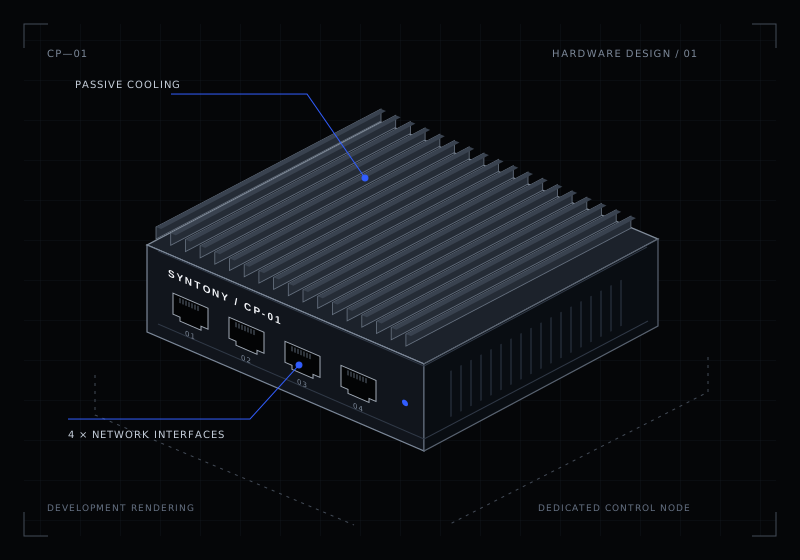
The first CP-01 profile is an application broker on a compact, fanless appliance. Agent requests terminate at the broker; approved connectors make separate calls to the test service. IPv4 and IPv6 forwarding remain disabled.
Requests a bounded tool call
No target credentialsPolicy + grant verification
Application broker + connectors
Receives connector calls
Scoped destination and APIThe working prototype mediates fixed in-memory services. Network ingress, destination credential custody and real service connectors are required appliance integrations; private supervisor IPC is not an agent-facing interface.
Fanless. Four wired interfaces.
Dedicated management path.
Protectli VP2430e. Optional TPM-02 configuration subject to OEM confirmation; appliance integration is in development.
Two distinct enrolled operators sign an exact request using separate PIV keys. The adapter is implemented; physical-token ceremony tests are next.
The TPM is intended for device-key custody and boot measurements checked against an approved policy. This integration is separate from operator authorization and remains to be built.
Separate management, agent and target interfaces. The fourth port is reserved and disabled by default. Physical roles are verified during commissioning.
Planned logical port roles
03 / Control mechanisms
The controller binds approval to a complete request and consumes that grant once. STOP closes new admissions and reports any work already admitted; recovery requires fresh authorization.
Software foundation / appliance integration next
The software prototype separates the controller and synthetic broker from the workload process. CP-01’s appliance profile moves that service boundary to a separately managed host, with target credentials held by its connectors.
Host independence requires the commissioned topology and real connector path. The prototype alone demonstrates process separation.
What the stop means
Already admitted work is tracked separately. A returned acknowledgement does not undo completed effects or cancel a job a remote service has accepted.
Separate qualification work package
A fail-disconnected interlock beyond CP-01’s target interface is under consideration for independent link interruption. No device is selected or qualified. It would interrupt that link; remote jobs and other paths remain separate concerns.
04 / Existing software evidence
This 72-second narrative presents an archived Linux fixture on a shared kernel. It covers software denials and resource checks, preceding CP-01’s dual-operator controller work. It is not an appliance, current authorization or egress-cutoff test.
The recorded fixture will load after integrity verification.
Record verification pending
Verifying the recorded fixture…
Software-managed signer · Shared host kernel
Loading recorded data…
Playback unlocks after verification of the signed public record. The chapters are explanatory narration, not a measured execution timeline. Historical AEGIS identifiers remain unchanged.
Verification pending.
Download signed record ↓05 / Development path
The controller and bounded broker provide a working software foundation. The next release must connect that mechanism to a real test service and qualify the physical deployment.
Software controls / implemented
Single-use grants, replay rejection, bounded synthetic tools, in-flight accounting and signed records. Tests exercise races, changed arguments and denied paths.
First appliance integration / next
Authenticated, size-bounded request ingress; a fixed connector with credentials off the agent host; forwarding disabled; isolated management. Measure request rejection and stop behavior from the target side, including already admitted calls.
Trust and recovery / qualification
Test physical PIV approvals, enrollment, revocation and recovery. Integrate TPM device keys and boot measurements with explicit verification policy. Operator authentication and platform attestation are separate results.
Independent link interruption / separate work package
Select and test a fail-disconnected device against a defined controller-failure model. Measure established traffic, power loss and recovery before making a physical-cutoff claim.
Technical review
Discuss an agent, a test service and the action you need to control. Review the software prototype or explore the CP-01 hardware design with our team.
Request technical demonstration