Case 01
Terrorist and extremist misuse
More than 30 public cases in which AI acted as an operational assistant, linked to more than 70 deaths. TVE is not a named risk domain in frontier frameworks.
Syntony / Research / Report
Terrorist misuse, wartime misinformation, attacks on testimony archives and deepfakes of prisoners of war already happen. We map them as one system and show how they lead to catastrophic risk.
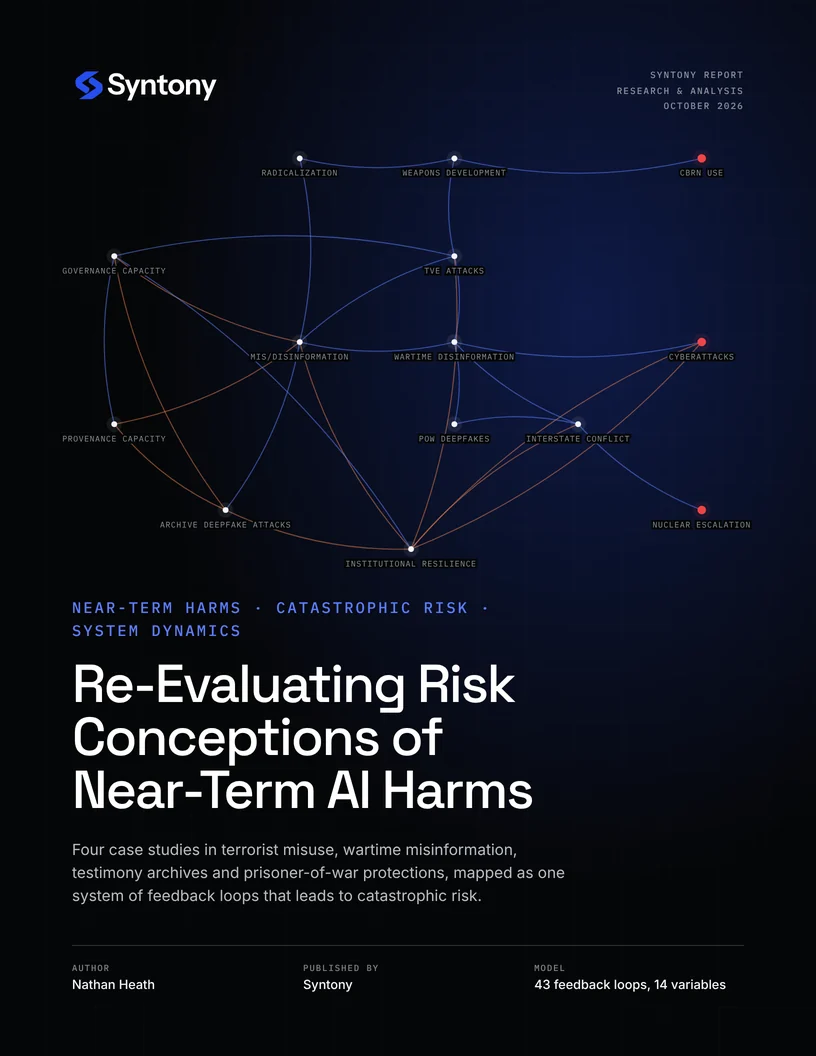
Syntony report · Nathan Heath · October 2026 · 29 pages
Frontier safety frameworks concentrate on CBRN uplift, cyber offense and loss of control. Terrorism and violent extremism, wartime misinformation, human rights harms and threats to international humanitarian law are handled in pieces through content policies and broad testing.
This report argues that near-term harms deserve more weight because they connect to catastrophic outcomes. It draws on four case studies, each paired with a red teaming scenario, and maps them as a causal loop diagram in the system dynamics tradition.
All 11 near-term variables in the model have a path to CBRN use, nuclear escalation and large-scale cyberattacks.
Four case studies
Each case pairs documented incidents with a red teaming scenario. Model responses are described by category only.
Case 01
More than 30 public cases in which AI acted as an operational assistant, linked to more than 70 deaths. TVE is not a named risk domain in frontier frameworks.
Case 02
An AI chatbot misidentified a ship’s cargo, and the resulting intelligence report came close to a boarding operation against a Chinese vessel.
Case 03
AI-generated portraits of fake Holocaust victims distort the memory of real ones. Archives lack the tools and red teaming to defend their records.
Case 04
AI-generated images of “captured” U.S. troops spread during the Iran war. The Third Geneva Convention predates generative AI.
The model
Fourteen variables and 26 signed links. A loop is reinforcing when it has an even number of negative links and balancing when the number is odd.
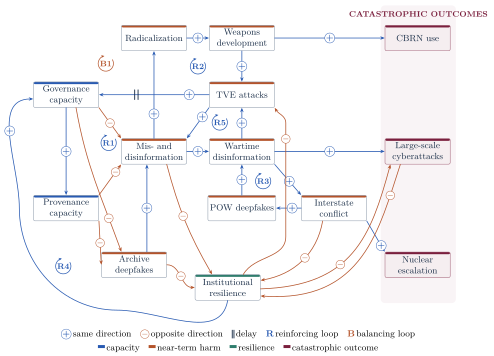
Figure 1. A qualitative model of structure. Links are hypotheses drawn from the case studies and cited literature and have not been weighted or validated.
The report includes the Python code behind both causal loop diagrams. We reran it with NetworkX 3.7 for this edition, and it reproduces the published counts. Download the files and check them yourself.
43 loops: 21 reinforcing, 22 balancing
Mis/disinformation         on 37 of 43 loops
Governance capacity        on 36 of 43 loops
Institutional resilience   on 32 of 43 loops
TVE attacks                on 27 of 43 loops
Wartime disinformation     on 24 of 43 loops
22 of 22 balancing loops pass through the delayed TVE -> governance link
11 of 11 near-term variables reach all three catastrophic outcomes
Recommendations
Governance capacity and institutional resilience lie on 36 and 32 of the 43 loops, so strengthening them weakens the paths to catastrophe too.
Name TVE, wartime misinformation and IHL harms in lab frameworks, system cards and the EU Code of Practice, with risk assessments and escalation criteria. Label and verify AI-derived intelligence before it informs kinetic action.
Run phased exercises with counter-terrorism, IHL, archival and humanitarian experts. Combine automated and human testing, and measure the harm itself, not refusal rates alone.
Content credentials, watermarking and tamper-evident logs for archives, POW records and intelligence products, with funding for the institutions least able to afford them.
Share jailbreak patterns and misuse signatures as well as hashes, and build incident reporting with common fields for armed conflict.
Hear the research
Nathan Heath presents this work as “Re-evaluating AI Risk for Human Impact: Four Case Studies in Near-Term Harm” on Thursday 5 November 2026, 17:30 to 19:00 GMT.
We red team for TVE, wartime misinformation and IHL harms, review risk frameworks and map systemic risk with Resonance. We aim to reply within two business days.