A model follows hostile instructions embedded in retrieved content.
AI evaluation · governance · assurance
We jailbreak AI systems
We jailbreak AI systems
Then we fix the governance
Syntony runs red-team and evaluation work on models and agentic workflows. We evaluate AI risks through rigorous testing, then help organizations strengthen AI governance and assurance.
EvaluateRed teams and evaluation for models, agents, and workflows
GovernTechnical findings used in governance decisions
AssureVersioned tests and change reviews over time
syn·to·ny /ˈsɪntəniː/ noun
The handoff after a finding
A sound finding can still go nowhere if the client cannot reproduce it or fit the response into an existing review process. Syntony preserves the test record while the responsible team decides what to change.
The assurance loop
From finding to system change
A useful evaluation enables a client to replay failures and judge mitigations. The same case should run again after remediation or a material change to the system.
Trace, prompt, tool call, affected privilege, and replayable test case.
System security owns remediation. The program owner owns release conditions.
Content isolation, tool-call approval, and a retrieval allowlist.
Hold privileged tool use from untrusted retrieved content until the control passes.
Replay the attack after remediation. Run it again whenever the model or retrieval layer changes materially.
Services
Evaluation, governance, and ongoing assurance
We can start by testing a system or by working through an existing finding. We also help clients improve ongoing assurance programs. Syntony provides additional research and engineering services to strengthen the core red teaming-to-assurance pipeline.
Evaluate
Red-team and test models, agents, benchmarks, and AI-enabled workflows under realistic and adversarial conditions. Keep the test cases and traces ready to replay.
Explore evaluation →Govern
We work with the client team that has to respond, turning technical findings and policy commitments into clear responsibility, operating controls, and a review process people can use.
Explore governance →Assure
Keep versioned tests current and review the response when the model, data, integration, or operating context changes. This gives clients a current basis for the next release or risk decision.
Explore assurance →
Products
Products in development
Syntony is building three products around recurring problems in AI evaluation and governance.
Governance Lag Monitor
Tracks whether public frontier-AI findings lead to documented controls or decisions, and how long that response takes.
Explore the Monitor →Resonance
Maps attack paths through a customer’s AI system. Each path stays linked to the test record, the responsible team, the response, and the next test.
Open the risk map →GovTune AI
Drafts governance records from red-team traces, enabling organizations to assign responsibility and plan mitigations while preserving the decision workflows.
Explore GovTune AI →
Who we work with
Organizations that need usable AI test results
Syntony works with AI labs, public agencies, companies, universities, nonprofits, and civil-society groups, adapting methodology and deliverables to each institution’s authority and practical constraints.
Founder-led
Nathan Heath
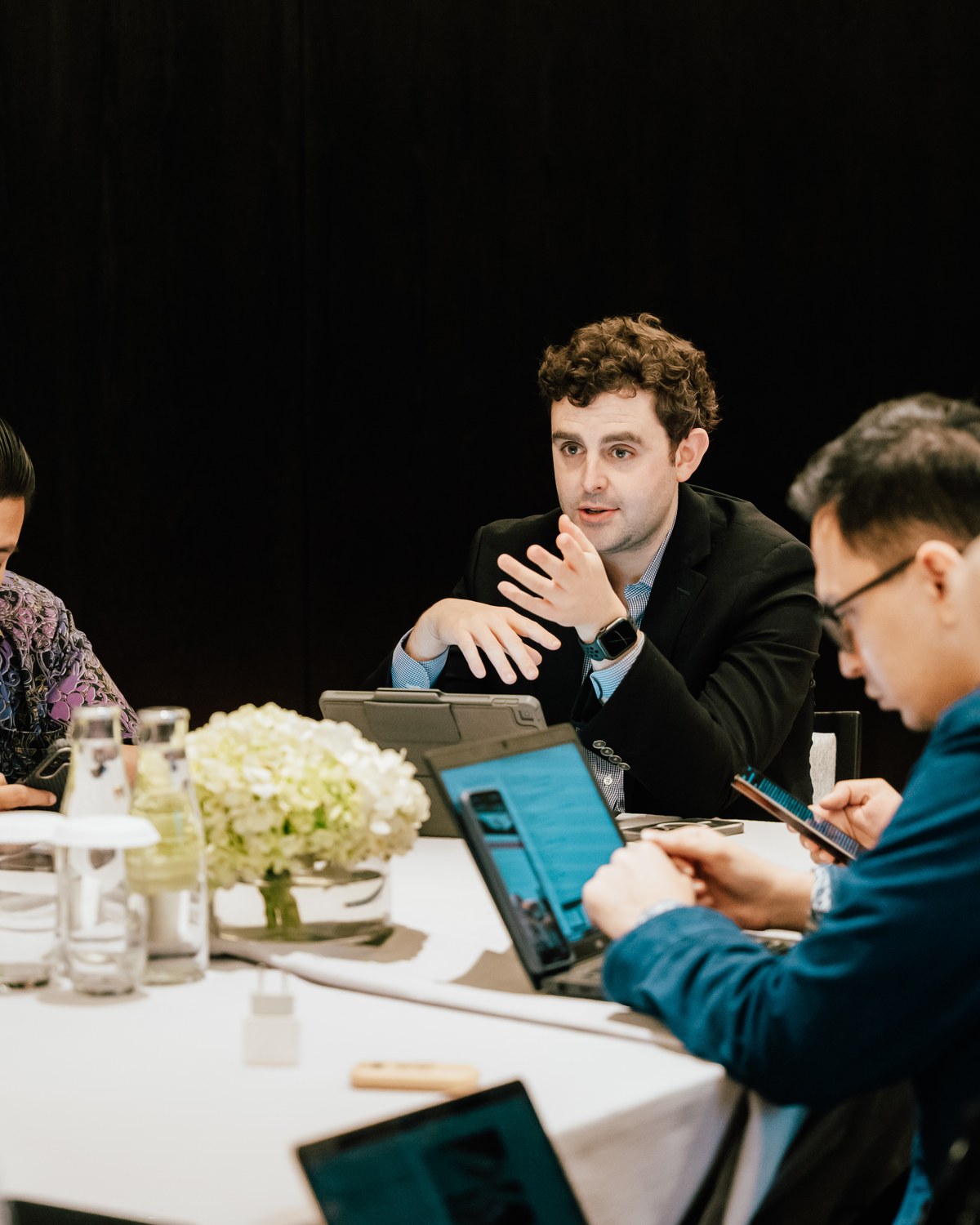
Nathan founded Syntony after seeing technically strong evaluation work fail at the handoff to governance and release teams. He is a decision scientist and AI safety researcher who has worked on geopolitics and emerging technology since 2012.
Nathan red-teams frontier models for OpenAI and Anthropic. He also co-founded The AIHL Project. Before Syntony, he spent six years as a decision scientist at National Security Innovations supporting U.S. Department of Defense clients on emerging-technology risk, AI integration, and security cooperation.
He is a Truman National Security Fellow and advises the Cloud Security Alliance on catastrophic AI risk. He also contributes to the Oxford Martin AI Governance Initiative. Nathan has presented his work at IASEAI at UNESCO, UNIDIR, the Cambridge Centre for Geopolitics, and the UK MoD Deterrence and Assurance Academic Alliance. His writing has appeared in War on the Rocks, RAND Europe, World Politics Review, PRISM, and The Washington Post.
OpenAI & Anthropic Red TeamerTruman Security FellowCSA Expert AdvisorOxford Martin AI Governance
Contact
Talk with Syntony
Tell us what needs testing or what decision you need to make. We’ll recommend an initial scope and explain what expertise it requires. NDA discussions are standard.
Engagement boundary: Syntony provides evaluation, governance, research, engineering, and decision support. Clients retain responsibility for external relationships and decisions controlled by third parties.
Do not include classified information, CUI, export-controlled data, credentials, client evidence, or other sensitive system details in public email or scheduling fields. We will establish an appropriate channel before evidence transfer.