+ Evaluation / Governance / Assurance
Test the system.Check the fix.
We test AI, robots, quantum computers, and other advanced technologies. We help teams find failures, decide what to change, and check that the changes work.
SYNTONY / SYSTEM STUDIES
EST. 2026
02 PHYSICAL AI Autonomy meets reality.
DRAG TO ORBIT ↺ Ⅱ
Perception → decision → physical action INTERACTIVE 3D STUDY
CHOOSE A SYSTEM 12 systems to explore →
Our team’s experience spans
Our work has been featured at
Featured products / Hardware & software
What we're building.What you can use.
01 / Control hardware & software
METRONOME A separate control appliance for agent evaluation. ME-01 is designed to keep request approval and destination credentials outside the AI host.
In development · Appliance integration next ME-01 / Enclosure study Development rendering
02 / AI evidence investigator
Evidagio Recalculate supplied test results, find missing evidence and export a record for human review. Try the local demo or explore self-serve access.
Local demo + self-serve access EVIDENCE_SNAPSHOT CASE / 001
Count every
79.2%
95 SUCCESSES / 120 ATTEMPTS
CALCULATION REPRODUCED
SOURCE UNVERIFIED
HUMAN REVIEW REQUIRED
Illustrative evidence snapshot No live system tested
03 / Systems thinking & dynamics
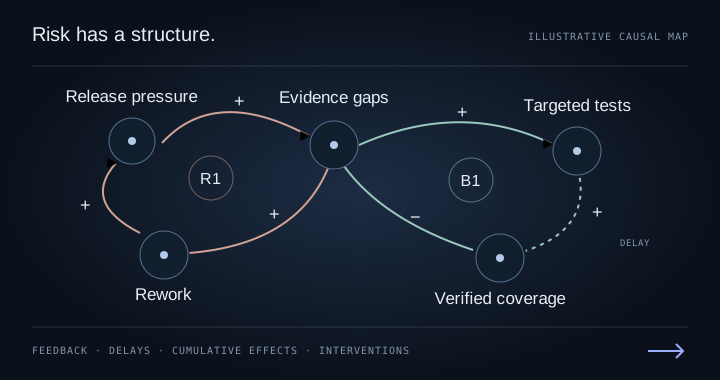
Resonance Map how risks interact. Trace feedback loops and delays, examine how failures spread, and compare interventions with red-team evidence in view.
Pilot inquiries open SYSTEM MAP / 01 CAUSE → EFFECT
Feedback loops & interventions Illustrative model
04 / Regulatory & policy alignment
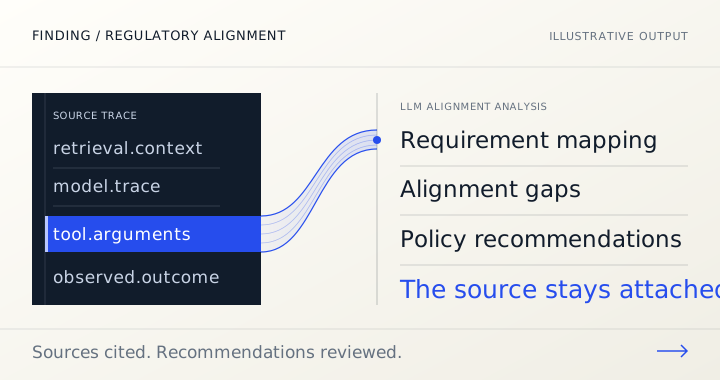
GovTune AI A proprietary LLM that analyzes red-team findings against AI regulatory requirements worldwide. Create policy frameworks, find alignment gaps and review source-linked recommendations.
Pilot inquiries open FINDING → REQUIREMENT → RECOMMENDATION REVIEW / 01
Source-linked alignment Example workflow
05 / A new software product
Coming Soon2027 Something new is taking shape. Enter the preview for a first look.
Coming in 2027 2027
SOMETHING NEW
Syntony / Software Coming soon
01 METRONOME02 Evidagio03 Resonance04 GovTune AI05 Coming Soon / 2027
Pilot scope and availability are agreed with your team. Explore the examples to see how each product works.
Explore all products ↗
Action control Check an action, enforce its limits, and recheck when the evidence changes.
Agent supervision You already have an orchestrator. Now assign a first chair to lead it.
01 / The pressure lab
CASE 02 / PHYSICAL AI
A clear path. A robot plans a route from a sensor reading. What happens when that reading is stale, but the movement command still looks valid?
ASSUMPTION UNDER TEST The location estimate is recent enough to authorize movement.
Inspect the system ↑
OPERATING LIMITS BASELINE
01 Observe02 Disrupt03 Constrain04 Re-test
The system is operating within its assumed limits. Introduce a disruption to expose the dependency behind the action.
Introduce disruption → Reset scenario ↺
A conceptual model, not a measured safety score. Change the pressure and compare the response.
02 / How systems depend on each other FOLLOW A FAILURE
One failure can A robot needs sensors. A sensor needs a clock. A remote operator needs a network. We test what happens when those dependencies fail.
01 / AI & AGENTS
AI agents that use tools. Test how agents use tools, memory, and delegated permissions.
FOLLOW ONE FAILURE PATH Retrieved content → delegated authority → external action
Explore this scenario ↗ HOW WE SUPPORT YOU Test failures and record what happened Set permissions and name decision owners Repeat tests when the system changes
+ CHOOSE A FAILURE. FOLLOW ITS PATH.Illustrative dependencies. Each engagement starts with the actual system.
03 / The Syntony method TEST → DECIDE → FIX → TEST AGAIN
01 Question Agree what we need to find out. ↗ 02 Evidence Run the test. Record what happened. ↗ 03 Action Name who acts and what must change. ↗ 04 Re-test Check the fix and the work it must still allow. ↗
PHYSICAL AI ILLUSTRATIVE RECORD
What needs to be true Agree what the system is meant to do, who could be affected, and what the test must show.
05 / Work with Syntony A CLEAR QUESTION. A USEFUL RESULT.
What do you We help labs, companies, public agencies, and civil society test advanced technologies and decide how to use them.
01 Evaluate Red teaming, evaluation design, ↗ 02 Govern Decision rights, operating controls, ↗ 03 Assure Re-testing, change assessment, ↗ 04 Look ahead Emerging risks, system dependencies, ↗
06 / Who we work with SYSTEMS IN THEIR WORKING CONTEXT
× ABOUT THE EXPERIENCE
Make the method tangible. These interactive studies use fictional systems and simplified rules to demonstrate how a finding can change a decision, operating limit, or control. They contain no client data and do not represent measured performance, a validated physical model, or a certification.
The 3D objects are original procedural illustrations. Every real engagement requires a defined system, threat model, evidence, relevant specialists, and scope of assurance.
Research foundations The control principles presented here are a Syntony design framework; applying them requires domain-specific validation.